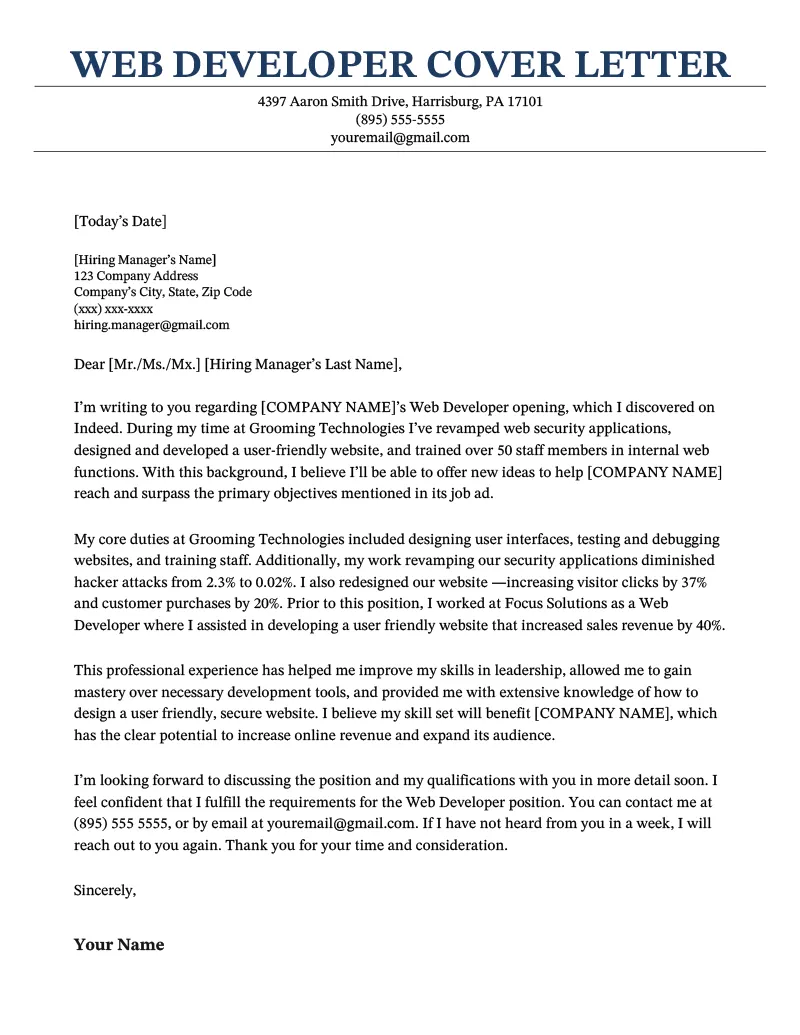
What is a Web Developer Cover Letter?
A web developer cover letter is a crucial document accompanying your resume when applying for web development positions. It serves as a personalized introduction, allowing you to showcase your skills, experience, and enthusiasm for the specific role and company. Unlike a resume, which provides a factual overview of your qualifications, a cover letter enables you to tell your story and explain why you are the ideal candidate. It’s your chance to make a strong first impression and persuade the hiring manager to read your resume and consider you for an interview. A well-crafted cover letter highlights your personality and communication skills, setting you apart from other applicants.
Why is a Cover Letter Important for Web Developers?
In the competitive field of web development, a cover letter provides a significant advantage. It allows you to go beyond the bullet points of your resume and demonstrate your understanding of the company’s needs and how your skills align. This personalized approach showcases your genuine interest and attention to detail, qualities highly valued by employers. A cover letter allows you to articulate your problem-solving abilities, creativity, and communication skills – all essential for web developers. Furthermore, it’s an opportunity to address any potential gaps in your experience or explain career transitions, giving you more control over your narrative. Many employers still consider a cover letter a key part of the application process, using it to assess your writing skills, professionalism, and overall suitability for the role.
Key Components of a Web Developer Cover Letter

A well-structured cover letter follows a standard format to ensure clarity and professionalism. Each section plays a specific role in presenting your qualifications and making a compelling case for your candidacy. Here are the key components you should include to create a impactful cover letter. Remember to keep your tone professional and enthusiastic throughout, highlighting your strengths while remaining concise and focused. A well-organized cover letter demonstrates attention to detail and a strong understanding of professional communication, essential traits for a web developer.
Header
Your Contact Information
At the top of your cover letter, include your full name, phone number, email address, and optionally, your LinkedIn profile URL or personal website. Ensure this information is accurate and up-to-date. This allows the hiring manager to easily contact you for the next steps in the hiring process, so accuracy is crucial.
Date

Below your contact information, write the current date. This helps the employer know when you submitted your application. Be sure to use a professional date format.
Employer’s Contact Information
Include the hiring manager’s name (if known), their title, the company name, and the company address. Addressing the letter to a specific person shows you have done your research and demonstrates your attention to detail. If you can’t find the hiring manager’s name, use a general salutation like “Dear Hiring Manager.”
Salutation
Start your cover letter with a professional salutation, such as “Dear Mr./Ms. [Last Name]” if you know the hiring manager’s name. If not, use “Dear Hiring Manager.” Avoid generic greetings like “To Whom It May Concern.” Make sure that the salutation aligns with the company’s culture and the specific role you are applying for. A personalized salutation can establish a friendly connection from the beginning.
Body Paragraph 1 Introduction and Enthusiasm

This is your opportunity to make a strong first impression. Begin by stating the position you are applying for and where you found the job posting. Briefly express your interest in the role and the company, demonstrating your enthusiasm. Show the hiring manager your understanding and passion for web development. Make it clear why you are excited about this specific opportunity. It helps to directly state your excitement and what attracted you to the company.
Expressing your interest
Clearly state the position you are applying for and mention how you learned about the opportunity. This can be through a job board, a company website, or a referral. This helps the hiring manager quickly understand the context of your application.
Highlighting your passion
Express your enthusiasm for web development and the specific company. Explain what excites you about the role and why you are interested in working there. Show that you’ve done your research and understand the company’s mission, values, or products. This demonstrates your genuine interest and commitment.
Body Paragraph 2 Skills and Experience

This section is where you showcase your technical skills, experience, and achievements. Focus on the skills and experiences most relevant to the job description. Provide specific examples that demonstrate your abilities. Quantify your achievements whenever possible to show the impact of your work. Use keywords from the job description to demonstrate that you meet their requirements. Be clear and concise, highlighting your successes and emphasizing how your skills align with the needs of the role.
Technical skills and proficiency
List your technical skills, such as HTML, CSS, JavaScript, and relevant frameworks like React, Angular, or Vue.js. Mention your experience with databases, server-side languages, and any other technologies relevant to the job. Be specific and provide details about your experience with each skill. Mention your expertise level, such as beginner, intermediate, or expert.
Quantifiable achievements
Use numbers to quantify your accomplishments. Instead of saying “Improved website performance,” say “Improved website load time by 30%.” Provide examples of how you have solved problems, increased efficiency, or contributed to successful projects. Demonstrate how your work has directly benefited previous employers or clients. Make sure your achievements are relevant to the role.
Projects and portfolio

Mention specific projects you have worked on and the technologies you used. Include links to your online portfolio or GitHub repository. Describe your role in each project and highlight your contributions. Focus on the projects that best demonstrate your skills and experience. A well-organized portfolio is a crucial part of a web developer’s application.
Body Paragraph 3 Addressing the Job Requirements
Carefully review the job description and address the specific requirements and qualifications. Tailor your cover letter to match the employer’s needs, showing how your skills and experience align with their expectations. Show that you understand the role and what the company is looking for in a candidate. Explain your understanding of the company’s technical requirements and demonstrate your ability to contribute.
Matching your skills to the job description
Highlight the skills and experiences that directly match the requirements listed in the job description. Use the same keywords and phrases from the job posting to demonstrate that you meet their needs. Provide specific examples of how you have used these skills in previous roles. This shows the hiring manager that you are a strong fit for the position.
Explaining gaps

If there are any gaps in your employment history, address them in a positive and straightforward manner. Briefly explain the situation without making excuses. Focus on what you learned during the gap and how you have continued to develop your skills. Be honest and transparent about your career path. Try to provide a concise explanation that shows how you are staying up to date.
Body Paragraph 4 Closing and Call to Action
Conclude your cover letter with a strong call to action. Thank the hiring manager for their time and consideration. Express your enthusiasm for an interview and your availability. Proofread your letter carefully to avoid any errors. Reinforce your interest in the role and make it easy for the hiring manager to contact you.
Thanking the reader
Express your gratitude for the hiring manager’s time and consideration. A simple “Thank you for your time” is sufficient. This shows respect and professionalism.
Expressing your interest in an interview

Reiterate your interest in the position and express your eagerness to discuss your qualifications further in an interview. This demonstrates your commitment to the opportunity.
Mentioning availability
State your availability for an interview. You can say something like, “I am available for an interview at your earliest convenience.” This makes it easy for the hiring manager to schedule a meeting.
Closing
Use a professional closing, such as “Sincerely,” “Best regards,” or “Thank you.” Ensure that your closing aligns with the tone of your letter. Following the closing, include your full name and, if you are submitting a hard copy, your signature.
Common Mistakes to Avoid in Web Developer Cover Letters
Avoid these common pitfalls to ensure your cover letter makes a positive impression. Careful attention to detail and a professional approach will significantly improve your chances of landing an interview. Many applicants make mistakes that can ruin their chances of getting an interview. Here are some of the most common mistakes to avoid.
Typos and grammatical errors
Typos and grammatical errors are a significant turn-off. They demonstrate a lack of attention to detail and can make you appear unprofessional. Always proofread your cover letter carefully before submitting it. Use spell-check and grammar-check tools, but also read it aloud to catch any mistakes. Ask a friend or family member to review it as well. Ensure that the language used is clear and easy to understand.
Generic letters
Avoid using a generic cover letter that you send to every company. Tailor your cover letter to each specific job and company. Show that you have researched the company and understand their needs. Generic letters do not resonate with the hiring manager and indicate a lack of genuine interest.
Exceeding the recommended length
Keep your cover letter concise and to the point. Ideally, it should be no more than one page. Hiring managers are busy and do not have time to read long, rambling letters. Focus on the most relevant information and avoid unnecessary details. Being concise demonstrates respect for the hiring manager’s time.
Formatting issues
Use a clear and professional format. Choose a readable font, such as Times New Roman, Arial, or Calibri. Use appropriate spacing and margins. Ensure that your cover letter is easy to read and visually appealing. Poor formatting can make your letter difficult to read and may reflect poorly on your professionalism. Ensure that the formatting is consistent throughout.
Cover Letter Examples
Reviewing examples can provide inspiration and guidance when writing your own cover letter. These examples are tailored to different experience levels and job situations. They can help you understand how to structure your letter and highlight your skills effectively. It’s crucial to customize these examples to fit your unique skills, experience, and the specific job you are applying for.
Example 1: Entry-Level Web Developer
This example is for a recent graduate or someone with limited professional experience. The focus is on education, projects, and enthusiasm. Highlight any internships, personal projects, or coursework that demonstrates your skills and understanding of web development. Emphasize your eagerness to learn and contribute to a team. Showcase your relevant skills and interest in web development. Emphasize the candidate’s transferable skills and ability to learn.
Example 2: Experienced Web Developer
This example is for a web developer with several years of professional experience. Highlight your accomplishments, the technologies you have mastered, and the results you have achieved in previous roles. Use quantifiable achievements to demonstrate your impact. Mention any leadership roles, special projects, or contributions to open-source projects. This section should showcase the candidate’s ability to deliver results and contribute to the team.
Example 3: Freelance Web Developer
This example is for a freelance web developer. Highlight your experience with managing projects, working with clients, and delivering results on time and within budget. Include links to your portfolio and client testimonials. Demonstrate your ability to work independently, manage your time, and communicate effectively. Show the value of your skills, experience, and the specific technologies you can deliver.
Tips for Customizing Your Cover Letter
To make your cover letter stand out, personalize it to the specific job and company. Tailoring your letter shows that you have taken the time to understand their needs and are genuinely interested in the opportunity. This demonstrates your professionalism and commitment. Make sure that your letter is specific, personalized, and targeted to the role you are applying for.
Researching the company
Before writing your cover letter, research the company. Visit their website, read their mission statement, and learn about their products or services. Understand their culture and values. This will help you tailor your letter to their specific needs and demonstrate your interest. Understanding the company’s values will help you customize your letter.
Tailoring your letter to the specific job
Carefully review the job description and identify the key requirements and qualifications. Use the same keywords and phrases from the job posting in your cover letter. Highlight the skills and experiences that match the job requirements. Tailoring your letter ensures that it is relevant and shows the hiring manager that you are a good fit for the role. Ensure that your skills and experiences match what is required for the job.
Using keywords from the job description
Incorporate keywords from the job description throughout your cover letter. This helps the hiring manager quickly identify your qualifications and see how you match their needs. It also helps your application pass through applicant tracking systems (ATS). Keywords are crucial for getting noticed by both human recruiters and applicant tracking systems.
Proofreading and editing
Always proofread and edit your cover letter carefully before submitting it. Check for typos, grammatical errors, and formatting issues. Read your letter aloud to catch any mistakes. Ask a friend or family member to review it as well. A well-proofread cover letter demonstrates professionalism and attention to detail.