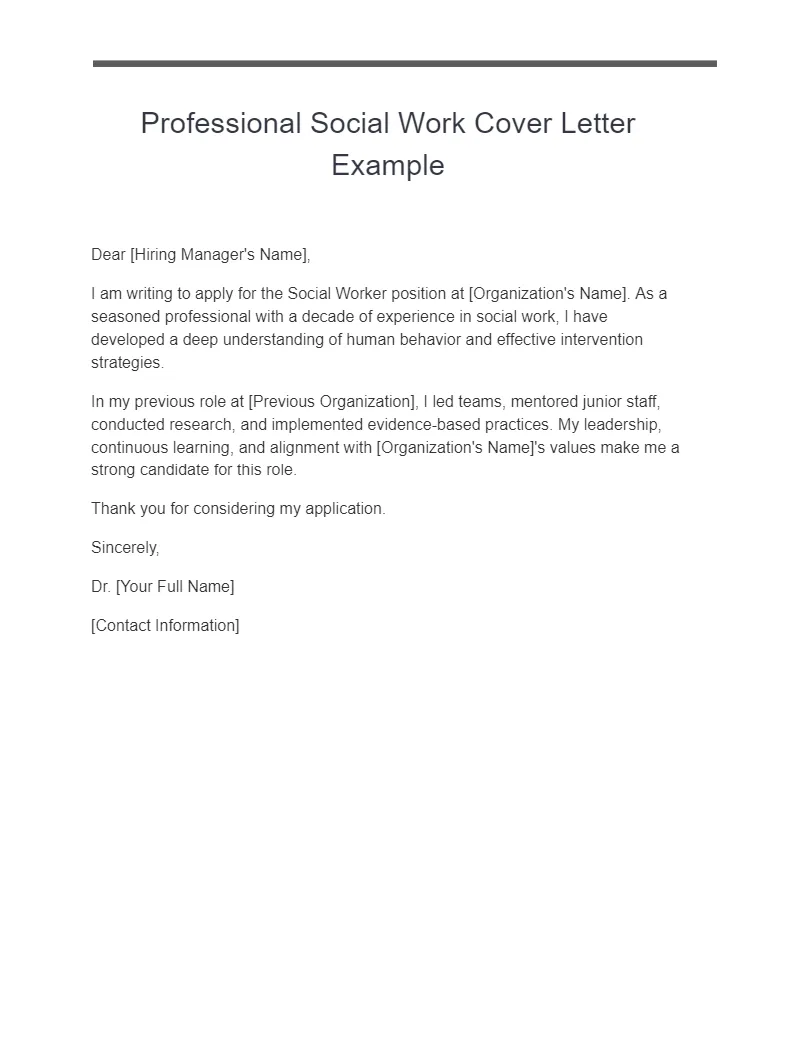
Understanding the Social Work Cover Letter
A social work cover letter is more than just a formality; it’s your first opportunity to make a positive impression on a potential employer. It serves as a crucial introduction, providing context to your resume and demonstrating your suitability for the role. Unlike a resume, which offers a summary of your qualifications, the cover letter allows you to showcase your personality, passion, and communication skills. It’s a chance to tell your story and explain why you are the perfect fit for the position and the organization. A well-crafted cover letter can significantly increase your chances of landing an interview, while a poorly written one can lead to immediate rejection. This guide will provide you with a comprehensive understanding of how to write a compelling social work cover letter that sets you apart from other applicants. This guide will also help you learn how to use the right keywords for your cover letter.
Why a Cover Letter Matters
In the competitive field of social work, a cover letter is essential. It allows you to personalize your application and highlight the specific aspects of your skills and experience that align with the job requirements. A well-written cover letter demonstrates your genuine interest in the position and the organization. It also gives you the opportunity to explain any gaps in your employment history or unique circumstances that may be relevant. Employers often use cover letters to assess your writing abilities, attention to detail, and communication style. Therefore, a strong cover letter can significantly improve your chances of getting noticed and securing an interview. Without a cover letter, your application may appear impersonal and less engaging, making it more difficult to make a positive first impression. In addition to this, cover letters show your knowledge of the role and the company.
Essential Components of a Social Work Cover Letter

A strong social work cover letter should include several key components to effectively convey your qualifications and enthusiasm. These elements work together to create a cohesive and compelling narrative that captures the reader’s attention and encourages them to learn more about you. It’s important to approach each section with a clear purpose, ensuring that every sentence contributes to the overall message of why you are the best candidate for the job. This section will guide you through each component, providing insights and examples to help you create a cover letter that makes a lasting impression. Remember that each component should be tailored to the specific job you’re applying for to show your knowledge of the role.
Header and Contact Information
Your cover letter should begin with a professional header that includes your contact information. This section should be clearly formatted and easy to read. Include your full name, address, phone number, and email address. Ensure that your email address is professional and appropriate. You may also include a link to your LinkedIn profile or online portfolio, if applicable. The header is the first piece of information the hiring manager sees, so make sure it’s clean and professional. This section is important as it allows the company to easily contact you for an interview. Be sure to double-check that all of your contact details are correct and up-to-date before submitting your cover letter. Look at the image above for more information on how to create a professional-looking header.
Professional Greeting
Begin your cover letter with a professional greeting. Whenever possible, address the hiring manager by name. Researching the name of the hiring manager demonstrates your initiative and attention to detail. If you are unable to find a specific name, use a general greeting such as “Dear Hiring Manager.” Avoid generic greetings such as “To Whom It May Concern.” A personalized greeting immediately grabs the reader’s attention and sets a professional tone for the rest of the letter. Make sure to spell the name of the hiring manager correctly and double-check this before submitting your cover letter. The professional greeting is important because it adds a personal touch and shows that you have taken the time to research the organization and the role.
Body Paragraph 1 Highlighting Your Skills

The first body paragraph should state the specific position you’re applying for and briefly explain why you’re interested in the role and the organization. This is your opportunity to make a strong first impression, so ensure your opening is clear and concise. Highlight your key skills and qualifications that align with the job description. Provide specific examples of your experiences, using the STAR method (Situation, Task, Action, Result) to showcase your accomplishments. This paragraph should quickly convey your suitability for the position and capture the reader’s attention. Use strong action verbs to describe your accomplishments and quantify your achievements whenever possible. The goal is to make the reader want to continue reading and learn more about you and your qualifications. See the image above for an example of how to highlight your skills. This paragraph sets the tone for the rest of the letter and should make the reader understand why you are interested in the role.
Showcasing Relevant Skills and Experience
In this section, provide details about your skills and experiences. Tailor the information to match the requirements of the job description. Mention specific projects, tasks, or situations where you successfully applied those skills. Quantify your achievements with numbers or percentages whenever possible to demonstrate the impact of your contributions. Focus on the experiences that are most relevant to the role, showcasing how your skills and experiences align with the organization’s needs. Use this section to demonstrate your understanding of the social work field and your ability to excel in the position. Give examples of how you have used your skills in the past, highlighting the results achieved. Be sure to use keywords from the job description in your letter to improve your chances of getting noticed by applicant tracking systems. This will help you stand out from other applicants, thus increasing your chances of getting an interview.
Body Paragraph 2 Demonstrating Your Passion
In the second body paragraph, express your genuine passion for social work and your commitment to helping others. Explain what motivates you to pursue this career path and why you are drawn to the specific organization or field. Share a personal anecdote or story that highlights your compassion, empathy, and dedication to social justice. This section should convey your emotional intelligence and your understanding of the values and principles of social work. Make sure to show your enthusiasm for the opportunity and your commitment to making a positive impact in the lives of others. Your passion will resonate with the hiring manager and demonstrate that you are more than just a qualified candidate, but also someone who is genuinely invested in the mission of the organization. Remember to tailor this section to the organization you’re applying to and explain why their mission aligns with your values. You can use examples from previous jobs or volunteer experiences to show your passion.
Expressing Your Dedication to Social Work

Demonstrate your dedication to the profession by highlighting your commitment to ethical practice, ongoing professional development, and your understanding of the challenges and rewards of social work. Discuss your awareness of relevant social issues, your ability to work with diverse populations, and your commitment to advocating for social justice. Share your understanding of relevant theories and methodologies, and explain how you incorporate them into your practice. This section is an opportunity to show that you are not just looking for a job, but also a dedicated professional committed to making a difference. Express your eagerness to learn and grow, and mention any additional training or certifications you have. Showing your dedication will show the hiring manager that you are a good fit for the role. Make sure to tailor the information to the organization and role, and mention any specific programs or initiatives that align with your values.
Body Paragraph 3 Mentioning the Employer
This section should focus on why you are interested in working for the specific organization. Show that you have researched the organization and understand its mission, values, and programs. Mention any specific aspects of the organization that resonate with you or that align with your professional goals. Explain how your skills and experiences can contribute to the organization’s goals, and why you believe you would be a valuable asset to their team. Demonstrate your understanding of their target population, services offered, and unique approach to social work. Tailor your letter to match the organization’s mission and values, highlighting your understanding of their work. By showing genuine interest, you will demonstrate that you are serious about the position and have taken the time to learn about the organization. Researching the company shows that you are truly interested in the role. This is a great way to stand out from other applicants.
Researching the Organization and Tailoring Your Letter
Before writing your cover letter, research the organization thoroughly. Visit their website, read their mission statement, and explore their programs and services. Look for recent news articles, social media posts, or any other relevant information that provides insights into the organization’s culture and values. Tailor your cover letter to reflect your understanding of the organization’s needs and goals. Mention specific programs or initiatives that align with your skills and interests. By demonstrating your understanding of the organization, you can show that you are genuinely interested in the role and committed to their mission. Use the image above to show you the best way to research the organization. Customizing your cover letter shows that you are not sending a generic application, but that you are making an effort. Customizing your cover letter shows the hiring manager that you care about the role.
Body Paragraph 4 Closing the Cover Letter

Close your cover letter with a concise summary of your key qualifications and a statement of your interest in the position. Reiterate your enthusiasm for the opportunity and your confidence in your ability to contribute to the organization’s success. Thank the hiring manager for their time and consideration. Express your willingness to provide additional information or participate in an interview. Keep your closing paragraph brief and focused. This will give the reader a better idea of your qualifications. Make sure to include your contact information, like your email and phone number. The closing paragraph is the last thing that the hiring manager sees. This section needs to be professional and clear. This paragraph is the final opportunity to reiterate your interest and show that you are the best fit for the job.
Formal Closing and Signature
End your cover letter with a professional closing, such as “Sincerely,” or “Respectfully.” Leave space for your signature above your typed name. If you are submitting your cover letter electronically, you can type your name and include a digital signature. Your signature is a final touch that demonstrates your professionalism. Make sure to use a professional closing and to spell your name correctly. Ensure your signature is readable and easy to understand. This is the final step in the cover letter, so make sure that it is well-formatted and easy to read. Your signature demonstrates the final step in the application. The image above is an example of how to format your cover letter and use the right closing.
Formatting Your Social Work Cover Letter
The format of your social work cover letter plays a vital role in its overall impact. Proper formatting makes your letter easy to read and allows the hiring manager to quickly find important information. It demonstrates your attention to detail and professionalism. Follow these guidelines to ensure your cover letter is well-formatted and visually appealing. A well-formatted cover letter reflects your professionalism and makes it easier for the hiring manager to understand your qualifications. These formatting tips will help you create a polished and professional document that makes a strong first impression. The formatting of your cover letter must be taken into account to make sure that it is professional. The font, margins, and layout are all important things that you must follow when creating the cover letter.
Font, Margins, and Layout

Choose a professional font such as Times New Roman, Arial, or Calibri with a font size between 11 and 12 points. Use 1-inch margins on all sides of the document. Align your text to the left, and use single spacing for the body of the letter. Include clear spacing between paragraphs to improve readability. Ensure that your header, closing, and signature are well-formatted and easy to read. Maintain a consistent style throughout the entire document. These guidelines will ensure that your cover letter is clean, professional, and easy to read. The image above demonstrates how to use these tips to create a well-formatted cover letter. The right format can help the hiring manager find information quickly.
Proofreading and Editing
Before submitting your cover letter, carefully proofread it for any grammatical errors, spelling mistakes, or typos. Read the letter multiple times, and consider having a friend, family member, or career advisor review it as well. Ensure that your language is clear, concise, and professional. Check for any inconsistencies in formatting or style. Proofreading is an essential step in the writing process, and it demonstrates your attention to detail. Make sure that the tone of your cover letter is appropriate for the role you are applying for. The image above shows you the best way to proofread your cover letter. Proofreading will show the hiring manager that you care about the role and that you have a keen eye for detail. A professional cover letter is essential for increasing your chances of getting an interview.
Mistakes to Avoid in Your Cover Letter
Avoid common mistakes that can diminish the impact of your cover letter and potentially lead to rejection. Be aware of these pitfalls and take steps to ensure your letter is free of these errors. A well-written and error-free cover letter is essential for making a positive impression and increasing your chances of success. By avoiding these common mistakes, you can significantly improve the effectiveness of your cover letter and increase your chances of landing an interview. The format of your cover letter, the language used, and the details provided all play a role in how the hiring manager views your application. Avoid making mistakes, and carefully review your letter before you submit it.
Common Errors and How to Fix Them

Avoid using generic or vague language. Tailor your cover letter to the specific job and organization. Avoid focusing solely on what you want (e.g., “I want this job”) and instead, highlight what you can offer the employer. Don’t simply repeat your resume; provide additional context and expand on your experiences. Always proofread carefully for any grammatical errors, spelling mistakes, or typos. Avoid negative language or complaining about previous employers. Ensure that your contact information is accurate and up-to-date. Fix any errors to ensure your cover letter is clear and professional. Make sure to customize your letter. If you have followed the steps above, then you are ready to submit your cover letter.
Examples of Strong Social Work Cover Letters
Reviewing sample cover letters can provide valuable insights into how to structure your own. Use these examples as inspiration and adapt them to your unique skills and experiences. Analyze the language used, the formatting, and the overall tone to gain a better understanding of what makes a cover letter effective. Reading examples can help you learn more about your goals and the best way to express them. The examples will provide inspiration and ideas for your own cover letter, and are a great place to start.
Sample Cover Letter 1 [Specific Role]
This example showcases how to tailor a cover letter for a specific social work role, highlighting relevant skills and experiences. It demonstrates how to address the key requirements of the job description. Make sure to review the job description, and then use the sample cover letter to help you build your own. Use this to review an example of how to highlight the right skills. Modify the letter to make it more personalized to fit your goals.
Sample Cover Letter 2 [Another Role]
This cover letter example demonstrates a different approach, perhaps for a different type of social work role or a different organization. Compare this example with the one above to understand how the approach changes based on the job and the organization. Use this to help you highlight your passion. Make sure that your cover letter includes the right skills and the right tone to make sure that the hiring manager is interested.
Tips for Tailoring Your Cover Letter
Tailoring your cover letter is crucial for demonstrating your genuine interest in the specific job and organization. Avoid using a generic template. Instead, customize each cover letter to reflect the unique requirements of the role and the values of the organization. Tailoring shows that you have taken the time to understand the job and the organization. This is a great way to increase your chances of getting an interview. Follow these tips to help you write a cover letter that is more effective. Tailor the cover letter to highlight the key skills and experiences that align with the job description. The more that you can tailor your cover letter, the better.
Keywords and Customization
Carefully review the job description and identify the key keywords and phrases used to describe the required skills and experience. Incorporate these keywords naturally throughout your cover letter. Highlight your relevant accomplishments and experiences using these keywords. Research the organization’s mission, values, and programs and tailor your letter to reflect your understanding of their work. Customize the language and tone to match the organization’s culture. Use the steps above to customize your letter. By tailoring your cover letter, you can show the hiring manager that you are the best candidate for the job. Always tailor the information to the role and organization.
Final Steps Before Submission
Before submitting your cover letter, review all the information. Make sure that you have followed the steps above and that the information is correct. Check the job description to make sure you have followed all of the requirements. Taking these steps can help you increase your chances of getting an interview. Don’t submit your cover letter until you have taken these steps to ensure that the information is correct. These are important steps to take before you submit your cover letter. Follow the steps, and you can increase your chances of getting the role.
Review and Submission Checklist
Use this checklist to ensure your cover letter is ready for submission. Proofread your cover letter. Verify your contact information is current and correct. Customize your cover letter. Review the job description to make sure your cover letter is aligned. Ensure your letter has a professional format. Review the tone and language. Save your cover letter with an appropriate file name. Submit your cover letter. By following these steps, you are making sure that your cover letter is ready for submission. This checklist is the final step to ensure that your cover letter is ready. Follow the steps to submit your cover letter. Use the steps above and the checklist to ensure that your cover letter is ready for submission. This is the final step to show that you have taken the time to create a professional cover letter.