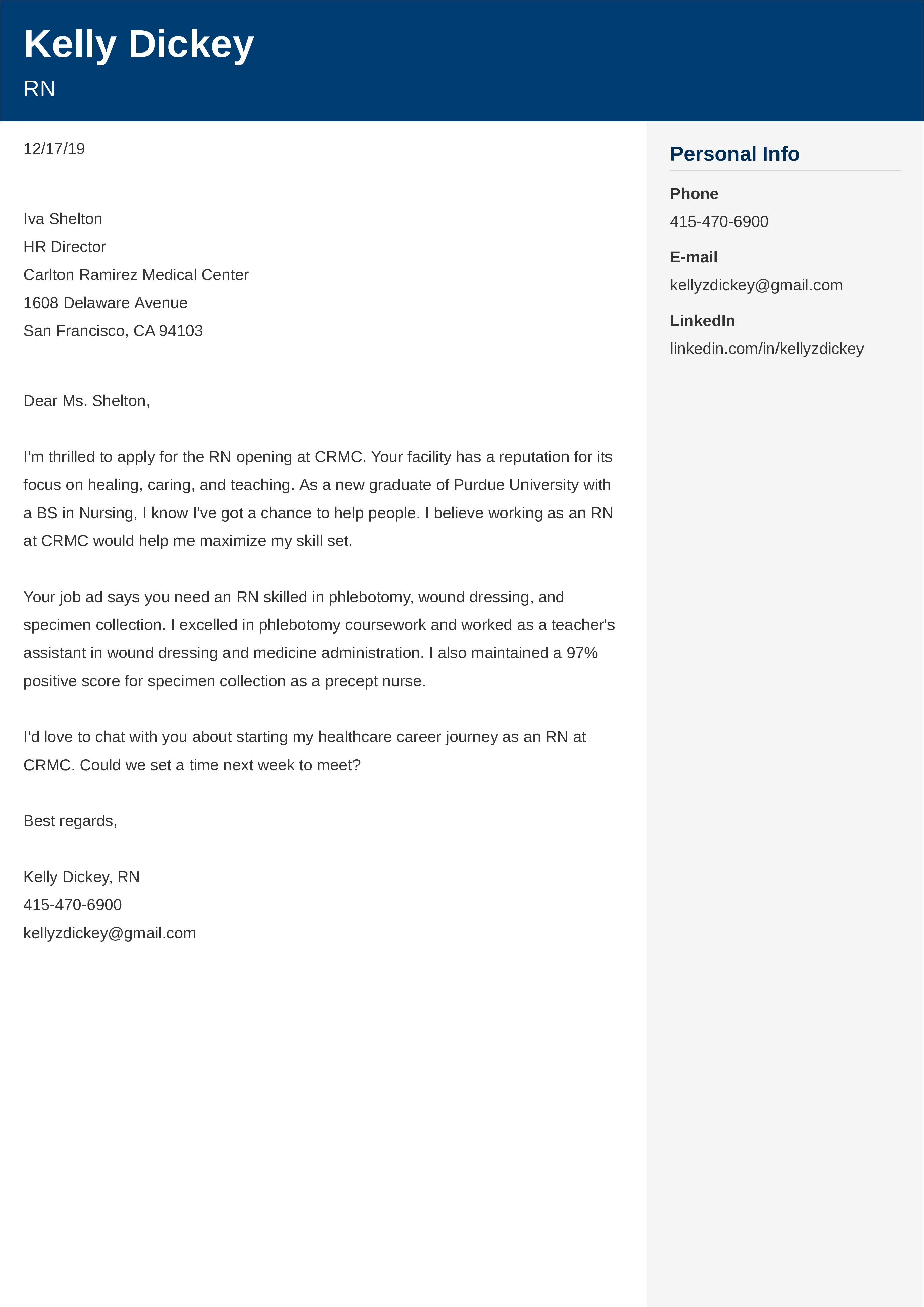
RN Cover Letter: Key Components
A well-crafted RN cover letter is your first opportunity to make a strong impression on a potential employer. It complements your resume, providing a concise overview of your skills, experience, and why you’re the ideal candidate for the nursing position. Unlike a resume, which lists your qualifications, a cover letter allows you to demonstrate your personality, express your enthusiasm for the role, and highlight the value you bring to the healthcare team. Mastering the art of writing an RN cover letter is crucial for career advancement, helping you stand out from other applicants in a competitive job market. A compelling cover letter showcases your understanding of the job requirements and your genuine interest in the specific organization, thereby increasing your chances of securing an interview.
Your Contact Information
Begin your cover letter with your contact information. This should be at the top of the page and include your full name, phone number, email address, and optionally, your LinkedIn profile URL. Ensure this information is accurate and up-to-date. Using a professional-looking email address is advisable; avoid nicknames or informal addresses. The inclusion of a LinkedIn profile allows the hiring manager to quickly assess your professional background and network. This section ensures that the employer can easily reach you to schedule an interview or request further information. Consistency in the presentation of your contact details with your resume is recommended, reinforcing your attention to detail and professionalism.
Date

Following your contact information, include the date. This signifies when the letter was written and helps in tracking the application’s timeline. The date format should be consistent throughout the document. Place the date directly below your contact details, aligning it either to the left or right margin. A well-placed and formatted date demonstrates organizational skills and professionalism. Using the correct date also allows the hiring manager to quickly assess the currency of your application and ensures they know when the letter was written. This might seem trivial, but it demonstrates attention to detail, a quality highly valued in healthcare professionals.
Hiring Manager Information
If possible, address your cover letter to a specific person. Research the hiring manager’s name and title; this shows you’ve done your homework and are genuinely interested in the position. If you cannot find the hiring manager’s name, use a formal greeting like ‘Dear Hiring Manager’ or ‘Dear [Department Name] Hiring Team.’ Using a specific name personalizes the letter and makes it more engaging, making a positive first impression and demonstrating initiative. Personalizing the letter will help the employer see that you are dedicated to the specific position you are applying for. The effort shows that you are more than just another applicant, but are truly interested in the job at hand.
Salutation
Use a professional salutation, such as ‘Dear Mr./Ms./Dr. [Last Name]’ when you know the hiring manager’s name. If you don’t know the specific person, use ‘Dear Hiring Manager’ or ‘To Whom It May Concern’. Avoid casual greetings like ‘Hi’ or ‘Hello’. The salutation sets the tone for the entire letter, so it should be formal and respectful. This helps to establish a professional tone from the start. Maintaining a professional tone from the start of your cover letter shows the hiring manager that you pay attention to detail. This shows that you know how to write a professional document. It demonstrates your understanding of business etiquette and respect for the hiring process.
The Opening Paragraph

The opening paragraph is your opportunity to grab the hiring manager’s attention. State the position you’re applying for and where you saw the job posting. Briefly mention your key qualifications and why you’re interested in the role. Highlight your enthusiasm and passion for nursing. This first paragraph should be concise, enthusiastic, and tailored to the specific job. Clearly state your intention to be considered for the position and express your excitement about the opportunity. Keep the opening paragraph succinct and engaging, making a strong first impression. This will encourage the hiring manager to read on and learn more about your qualifications.
Highlighting Your Skills and Experience
In the body of your cover letter, detail your relevant skills and experience. Tailor this section to the specific requirements of the job description. Use specific examples to demonstrate how your skills align with the role. Highlight your clinical expertise, patient care experience, and any specialized certifications you possess. Emphasize your ability to work effectively in a team, communicate with patients and families, and manage stressful situations. Quantify your accomplishments whenever possible to showcase your impact. The more specific and targeted your examples are, the more compelling your application will be. Demonstrating your ability to meet the required expectations will show that you can handle the job.
Quantify Achievements
Whenever possible, use numbers to quantify your achievements. Instead of saying ‘Managed a large patient load,’ state ‘Managed a patient load of up to 15 patients per shift.’ Quantifying your accomplishments provides concrete evidence of your abilities and impact. Numbers make your achievements more tangible and help the hiring manager understand the scope of your experience. Use metrics to showcase your efficiency, effectiveness, and contributions to previous employers. For instance, ‘Reduced patient readmission rates by 15%’ is more impactful than ‘Improved patient care.’ This will show the employer that you are more than qualified to handle the tasks at hand.
Tailor to the Job Description

Carefully review the job description and tailor your cover letter to match the requirements. Highlight the skills and experiences that are most relevant to the position. Use keywords from the job description to demonstrate that you understand the role and are a good fit. This demonstrates your attention to detail and your understanding of the organization’s needs. Customize each cover letter for each job application. Generic cover letters do not resonate with employers. Your attention to detail and tailored approach will signal your genuine interest in the role, significantly increasing your chances of getting noticed and chosen for an interview.
Expressing Enthusiasm and Interest
Throughout your cover letter, express your enthusiasm for the position and the organization. Explain why you are interested in this specific opportunity and what attracts you to their mission and values. Mention anything that shows your knowledge of the hospital, clinic, or healthcare system you are applying to. Demonstrating genuine interest can help you stand out. Express your passion for nursing and your commitment to providing excellent patient care. This can significantly enhance your application and increase the likelihood of an interview. This enthusiasm will help to show the employer that you are genuinely interested in the position at hand.
The Closing Paragraph
In the closing paragraph, reiterate your interest in the position and express your gratitude for the opportunity to be considered. Include a call to action, such as stating that you are available for an interview at their earliest convenience. Provide your contact information again. Keep the closing paragraph concise and professional. This reinforces your enthusiasm and leaves a lasting positive impression. This also helps the hiring manager take the next step. Be sure to thank the hiring manager for their time and consideration; this is a standard courtesy. A strong closing paragraph solidifies your interest and makes it easy for the hiring manager to take action.
Reiterate Interest and Gratitude

Reiterate your interest in the position and express your gratitude for the hiring manager’s time and consideration. Thank them for reviewing your application and express your enthusiasm for the possibility of an interview. Expressing gratitude is a standard professional courtesy, but it also reinforces your positive attitude. This reinforces your interest in the opportunity and leaves a favorable impression on the hiring manager. This will also make the hiring manager remember you and might give you an advantage over other applicants.
Proper Formatting and Proofreading
Formatting and proofreading are crucial to ensure your cover letter is professional and error-free. A well-formatted and carefully proofread cover letter reflects your attention to detail. Errors can create a negative impression and undermine your qualifications. Carefully review your letter for any grammatical or spelling errors. Ensure that the formatting is consistent and easy to read. Always proofread your cover letter before sending it, or ask a friend or colleague to review it for you. This is to guarantee that you do not leave any mistakes in your letter. This will show the hiring manager that you pay attention to detail, a key trait that they are looking for.
Formatting Guidelines
Use a standard font like Times New Roman, Arial, or Calibri, in a readable size (11-12 points). Use single spacing within paragraphs and double spacing between paragraphs. Maintain consistent margins (1 inch on all sides). Ensure that your letter is well-organized and easy to read. Keep the tone professional and avoid overly casual language. Proper formatting enhances readability and makes a positive impression. Following formatting guidelines makes it easy for the hiring manager to read your letter. A well-formatted letter demonstrates professionalism and attention to detail, showing respect for the hiring manager’s time. Consider this when formatting your cover letter for the next time.
Proofreading Checklist

Before submitting your cover letter, use a proofreading checklist. Check for spelling errors, grammatical errors, punctuation errors, and formatting inconsistencies. Verify that your contact information is correct and up-to-date. Ensure that the letter is tailored to the job description and that all required information is included. It’s also a good idea to read the letter aloud to catch any awkward phrasing. Proofreading meticulously ensures that your cover letter is polished and professional. Having someone else review your letter can also help to catch mistakes that you might have missed. This thorough review can make your cover letter stand out.
Common Mistakes to Avoid
Avoid common mistakes such as using generic cover letters, including irrelevant information, and making grammatical errors. Do not exceed one page in length, as hiring managers often have limited time. Be truthful and avoid exaggerating your qualifications. Avoid using jargon or slang that might not be understood by the hiring manager. Do not write the letter in a passive voice, be direct and assertive in your writing. These mistakes can make your cover letter less effective. A well-written and error-free cover letter is key. Avoiding these common mistakes shows professionalism and increases your chances of getting an interview.