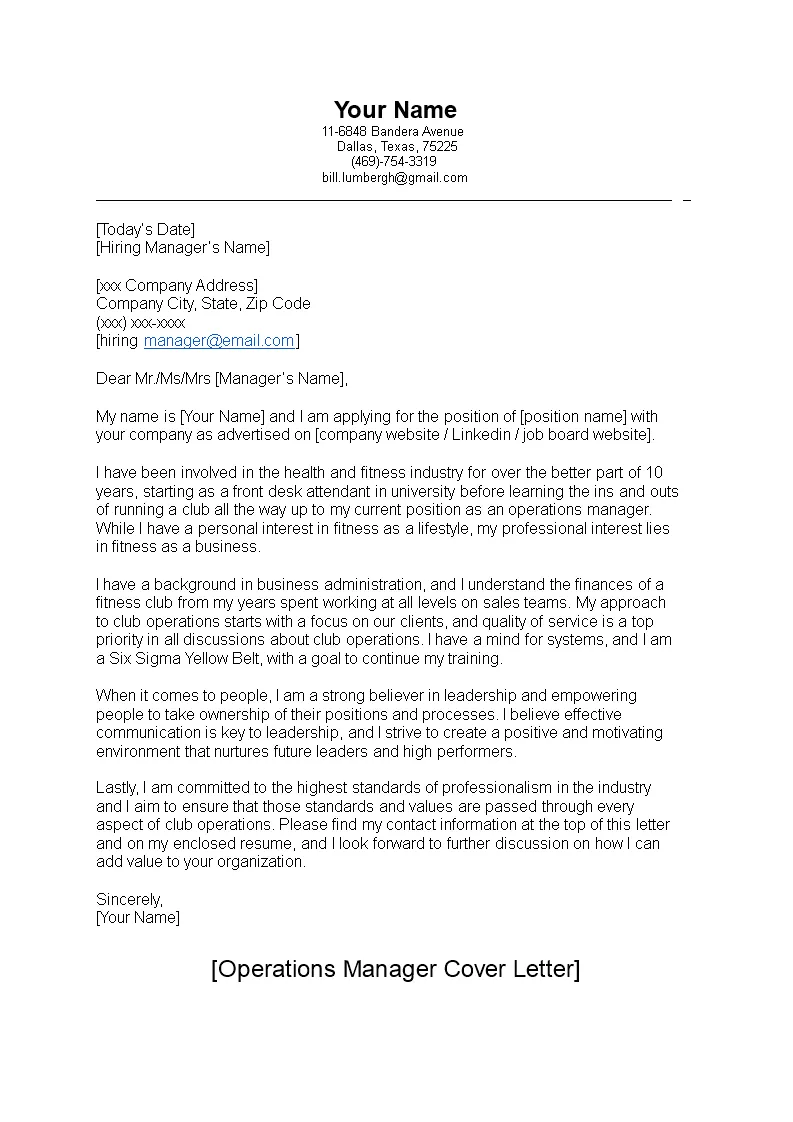
What is an Operations Manager Cover Letter
An Operations Manager cover letter is a crucial document that accompanies your resume when applying for operations management positions. It serves as your introduction to the hiring manager, providing a personalized narrative that showcases your relevant experience, skills, and qualifications. Unlike a resume, which presents a factual overview of your career, a cover letter allows you to elaborate on specific achievements, explain your career goals, and express your enthusiasm for the role and the company. A well-crafted cover letter can significantly increase your chances of securing an interview by demonstrating your understanding of the position and your ability to contribute to the organization’s success.
Why Is a Cover Letter Important for Operations Managers
In the competitive field of operations management, a cover letter provides a unique opportunity to differentiate yourself from other candidates. It allows you to connect your skills and experience to the specific requirements outlined in the job description. By highlighting your accomplishments and demonstrating your understanding of the company’s needs, you can create a compelling case for why you are the ideal candidate. Moreover, a cover letter gives you the chance to showcase your communication skills, which are essential for operations managers who must effectively communicate with various stakeholders, including employees, vendors, and senior management. A well-written cover letter demonstrates your professionalism, attention to detail, and ability to convey your value proposition.
Key Components of an Operations Manager Cover Letter

A comprehensive Operations Manager cover letter consists of several key components that work together to present a strong and persuasive argument for your candidacy. These components include your contact information and a professional salutation, an engaging opening that captures the reader’s attention, a body section that highlights your relevant experience and quantifiable achievements, and a closing that reinforces your interest and includes a call to action. Each component plays a vital role in creating a cohesive and impactful cover letter that effectively communicates your qualifications and enthusiasm for the position.
Contact Information and Salutation
Begin your cover letter by including your full name, address, phone number, and email address at the top. This ensures the hiring manager can easily contact you. Following your contact information, address the letter to the hiring manager or the specific person mentioned in the job posting. If a name isn’t provided, use a professional salutation such as ‘Dear Hiring Manager’ or ‘Dear [Company Name] Team.’ Avoid generic greetings like ‘To Whom It May Concern,’ as these lack personalization and can make your letter feel less engaging.
How to Write a Strong Opening
The opening paragraph is your chance to grab the reader’s attention and make a positive first impression. Instead of simply stating your interest in the position, try to create a hook. Mention a specific achievement, a company value that resonates with you, or a mutual connection. Briefly explain why you are excited about the opportunity and what makes you a strong fit for the role. Show enthusiasm and demonstrate your understanding of the company and the specific needs of the position. A compelling opening sets the tone for the rest of your cover letter and encourages the hiring manager to continue reading.
Highlighting Your Operations Experience

In the body of your cover letter, focus on your relevant operations management experience. Describe your previous roles and responsibilities, emphasizing experiences that align with the requirements of the job description. Provide specific examples of how you have successfully managed teams, streamlined processes, improved efficiency, and achieved business goals. Use action verbs to describe your accomplishments, such as ‘managed,’ ’led,’ ‘implemented,’ and ‘achieved.’ This section is where you demonstrate your skills and capabilities, showcasing why you are a qualified candidate.
Quantifying Your Achievements
One of the most effective ways to make your cover letter stand out is by quantifying your achievements. Instead of simply stating that you improved efficiency, provide specific numbers and metrics. For instance, you could say, ‘Reduced operational costs by 15% within one year’ or ‘Increased production output by 20% while maintaining quality standards.’ Using data-driven results demonstrates the impact you’ve had in previous roles and provides concrete evidence of your abilities. Whenever possible, use numbers to illustrate your accomplishments and showcase the value you can bring to the company.
Showcasing Relevant Skills
In addition to highlighting your experience, be sure to showcase your relevant skills. Operations managers need a diverse skill set, including leadership, problem-solving, communication, project management, and technical proficiency. Review the job description carefully and identify the key skills the employer is seeking. Then, provide specific examples of how you have demonstrated these skills in your previous roles. For instance, you could mention a time you successfully led a team through a challenging project, resolved a critical operational issue, or implemented a new process that improved efficiency. The more concrete examples you provide, the more compelling your cover letter will be.
Tailoring Your Cover Letter

A generic cover letter is unlikely to impress a hiring manager. To increase your chances of success, tailor your cover letter to each specific job application. This involves carefully reviewing the job description and identifying the key requirements and qualifications the employer is seeking. Then, customize your letter to address those requirements, highlighting the skills and experiences that are most relevant to the position. Avoid using a standard template without making any modifications. Tailoring your cover letter demonstrates that you are genuinely interested in the role and have taken the time to understand the company’s needs.
Company Research and Customization
Before you start writing your cover letter, research the company to gain a better understanding of its mission, values, and recent achievements. This will help you tailor your letter to the specific organization and demonstrate your genuine interest. Visit the company’s website, review its social media profiles, and read any recent news articles or press releases. Use the information you gather to customize your cover letter, mentioning specific projects, values, or goals that resonate with you. This shows the hiring manager that you have done your homework and are genuinely interested in joining their team.
Formatting and Proofreading Tips
Your cover letter should be well-formatted and free of errors. Use a professional font, such as Times New Roman or Arial, and maintain a consistent font size throughout the document. Use clear headings and subheadings to organize your content and make it easy to read. Keep the letter concise, ideally no more than one page. Before submitting your cover letter, proofread it carefully for any grammatical errors, typos, or formatting issues. A polished and error-free cover letter demonstrates your attention to detail and professionalism.
Formatting Your Cover Letter for Success

Proper formatting is crucial for making your cover letter easy to read and visually appealing. Use a standard business letter format with your contact information, the date, the hiring manager’s contact information, and a professional salutation. Use clear headings and subheadings to break up the text and guide the reader through your letter. Choose a readable font, such as Times New Roman or Arial, and use a font size of 11 or 12 points. Maintain consistent margins and spacing throughout the document. Avoid using excessive bolding, italics, or underlining, as this can make your letter look cluttered. Instead, use these formatting elements sparingly to emphasize key points.
Proofreading for Errors
Proofreading is an essential step in the cover letter writing process. Before submitting your letter, carefully review it for any grammatical errors, typos, spelling mistakes, or formatting issues. Read the letter aloud to catch any awkward phrasing or sentence structures. Consider asking a friend or colleague to proofread your letter as well. A fresh pair of eyes can often spot errors that you may have missed. A well-proofread cover letter demonstrates your attention to detail and professionalism, while a letter riddled with errors can create a negative impression.
Call to Action and Closing
End your cover letter with a strong call to action and a professional closing. Express your enthusiasm for the opportunity and reiterate your interest in the position. Clearly state that you are available for an interview and provide your contact information. Use a professional closing, such as ‘Sincerely’ or ‘Best regards,’ followed by your typed name. Avoid using clichés or overly casual language. A well-crafted closing reinforces your professionalism and leaves a positive lasting impression on the hiring manager.
Common Mistakes to Avoid

Several common mistakes can undermine your cover letter and reduce your chances of getting an interview. Avoid these pitfalls to create a compelling cover letter that showcases your qualifications. A sloppy cover letter can damage your prospects, so it’s crucial to avoid common errors.
Using Generic Language
One of the most common mistakes is using generic language that could apply to any job. Avoid phrases like ‘I am a hard worker’ or ‘I am a team player,’ as these are vague and don’t provide any specific evidence of your skills or accomplishments. Instead, use specific examples and quantify your achievements whenever possible. Tailor your language to the specific requirements of the job and avoid using a standard template without making any modifications. Show the hiring manager that you have taken the time to understand the position and are genuinely interested in the company.
Ignoring the Job Description
Another common mistake is ignoring the job description. The job description provides valuable information about the employer’s needs and expectations. Failing to address these requirements in your cover letter shows that you have not taken the time to understand the position or the company. Carefully review the job description and identify the key skills, qualifications, and experience the employer is seeking. Then, tailor your cover letter to address those requirements, highlighting the skills and experiences that are most relevant to the position.
Example Operations Manager Cover Letter Template

Below is a basic template that you can customize for your own cover letter. Remember to replace the bracketed information with your own details and tailor it to each specific job application. [Your Name] [Your Address] [Your Phone Number] [Your Email Address] [Date] [Hiring Manager Name (if known)] [Hiring Manager Title] [Company Name] [Company Address] Dear [Mr./Ms./Mx. Last Name], I am writing to express my enthusiastic interest in the Operations Manager position at [Company Name], as advertised on [Platform]. With over [Number] years of experience in operations management, I am confident that my skills and expertise align perfectly with your requirements. In my previous role at [Previous Company], I was responsible for [List Key Responsibilities and Achievements]. I am adept at [List Key Skills], and I am eager to apply my knowledge to contribute to [Company Name]’s success. Thank you for your time and consideration. I look forward to the opportunity to discuss my qualifications further. Sincerely, [Your Name].