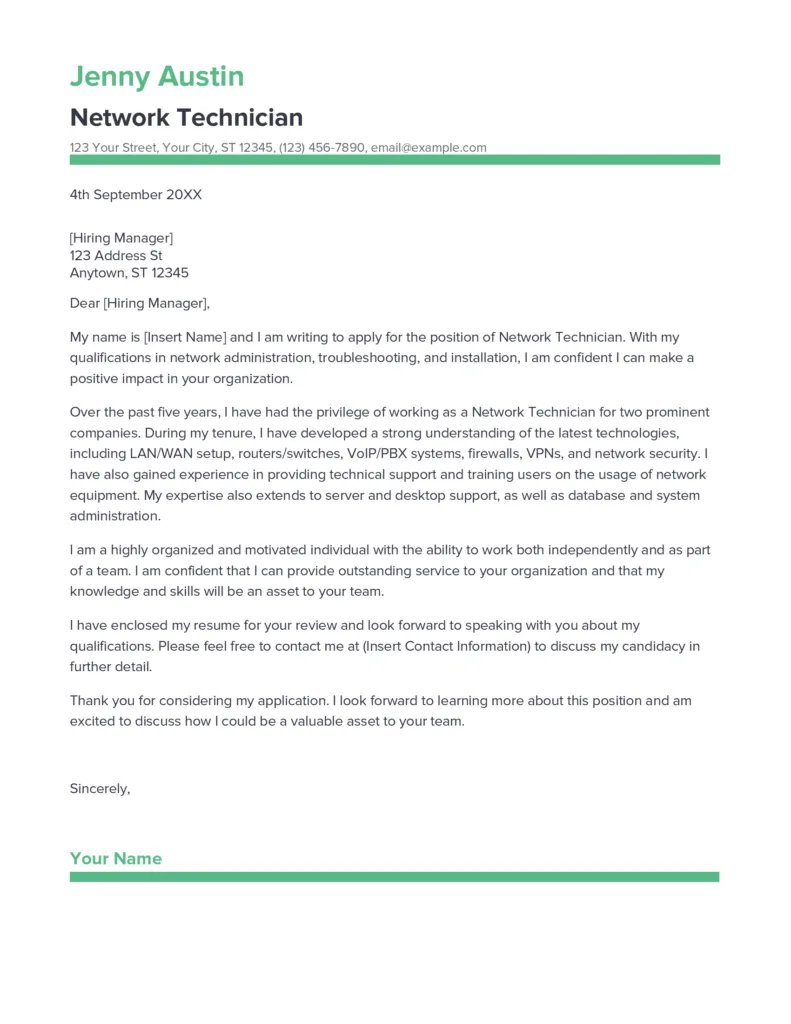
Understanding the Importance of a Network Technician Cover Letter
A Network Technician cover letter is your first introduction to a potential employer. It’s more than just a formality; it’s a critical tool in the job application process. A well-crafted cover letter can significantly increase your chances of landing an interview by highlighting your skills, experience, and enthusiasm for the role. In a competitive job market, a strong cover letter can set you apart from other applicants. It allows you to showcase your personality and explain why you are the best fit for the specific position and the company. Furthermore, it offers an opportunity to elaborate on your resume, providing context and depth to your qualifications.
Why a Cover Letter Matters
The cover letter serves as a personal introduction, allowing you to make a positive first impression. It demonstrates your communication skills and attention to detail, both essential for a Network Technician. It offers a space to personalize your application, making it clear why you’re interested in the specific job and company. Additionally, it complements your resume, providing context to your skills and experience, and highlighting how you’ve applied your knowledge. It allows you to address any potential gaps in your experience, such as a career change or a gap in employment. Most importantly, it enables you to express your genuine interest in the role, which can distinguish you from other candidates.
Highlighting Your Skills and Experience

A compelling cover letter must showcase your relevant skills and experience. Focus on technical skills such as network configuration, troubleshooting, and security protocols. Give examples of your accomplishments; use numbers to quantify your achievements. For instance, describe how you resolved a network outage and reduced downtime. Tailor your skills and experience to the specific job requirements. Research the company and the role to understand what they value most. By doing this, you can make your cover letter much more effective and engaging. Use keywords from the job description to demonstrate that you possess the qualities the employer is seeking.
Key Components of a Successful Network Technician Cover Letter
Contact Information and Salutation
Start with your contact information: name, address, phone number, and email. Always address your letter to a specific person, if possible. Research the hiring manager’s name on LinkedIn or the company website. Use a professional salutation, such as “Dear Mr./Ms. [Last Name].” Avoid generic greetings like “To Whom It May Concern,” as they make the letter seem impersonal. A personalized salutation shows you’ve taken the time to learn about the company and the role.
Crafting a Compelling Introduction

Your introduction is your chance to grab the reader’s attention. State the position you are applying for and where you found the job posting. Briefly highlight your most relevant skills and experience. Clearly express your enthusiasm for the role and the company. Be concise and focused; avoid unnecessary details. Consider using a brief anecdote to showcase your passion for network technology. For example, mention a specific project where you successfully implemented a network solution.
Showcasing Your Technical Skills
Clearly list your technical skills, such as experience with routers, switches, firewalls, and network operating systems. Mention specific technologies you’re proficient in, such as Cisco, Juniper, or specific cloud platforms. Explain how you’ve used these skills in past roles to solve network problems. Use action verbs to describe your accomplishments. Quantify your achievements whenever possible, for example, by mentioning the number of networks you have managed or the size of the team you have supported. Always keep your technical skills aligned with the job requirements.
Detailing Your Relevant Experience
Provide details about your previous roles, including the company name, your job title, and the dates of employment. Highlight the responsibilities and accomplishments that are relevant to the Network Technician position. Focus on projects where you demonstrated your network design, implementation, or troubleshooting abilities. Use the STAR method (Situation, Task, Action, Result) to describe specific situations and your contributions. The STAR method helps to structure your experience and demonstrate your problem-solving abilities effectively.
Quantifying Your Achievements

Whenever possible, quantify your achievements with numbers and data. For example, state the percentage reduction in network downtime you achieved or the number of users you supported. Quantifying your achievements demonstrates the value you bring to the table. This gives potential employers a clear picture of the impact you’ve made in previous roles. Specific numbers make your claims more credible and impactful. By using data to showcase accomplishments, you strengthen your application and make it more appealing to potential employers.
Expressing Enthusiasm and Interest
Show your genuine interest in the company and the role. Research the company’s mission, values, and recent projects. Explain why you are excited about the opportunity to work there. Describe how your career goals align with the company’s objectives. Mention specific aspects of the job that excite you. Highlighting your enthusiasm shows that you are genuinely interested and invested in the opportunity.
Proper Closing and Call to Action
Close your letter with a professional closing, such as “Sincerely” or “Best regards.” Reiterate your interest in the position and thank the reader for their time and consideration. Include a call to action by stating that you look forward to hearing from them or are available for an interview. Provide your contact information one last time. Proofread the entire letter to eliminate any errors before sending it.
Tips for Formatting and Proofreading

Formatting Best Practices
Use a professional font, such as Times New Roman, Arial, or Calibri, with a font size between 10 and 12 points. Keep the letter concise, ideally within one page. Use standard margins (1 inch) and double-space between paragraphs. Ensure your letter is easy to read. Use bullet points or numbered lists to highlight key skills or accomplishments. This can make your cover letter visually appealing and easier to scan.
Proofreading for Errors
Proofread your cover letter carefully for any spelling, grammar, or punctuation errors. Use a spell checker and a grammar checker, but don’t rely on them entirely. Read the letter aloud to catch any awkward phrasing or typos. Have a friend or colleague review it for a fresh perspective. Errors can create a negative impression of your attention to detail and professionalism.
Tailoring Your Letter to the Specific Job

Researching the Company
Before writing your cover letter, research the company and its mission. Visit their website, read news articles, and check their social media profiles. Identify the company’s values, culture, and recent projects. This will help you tailor your letter and demonstrate your genuine interest. Understanding the company’s needs helps you align your skills and experience with their requirements.
Matching Skills to Job Requirements
Carefully review the job description and identify the key skills and qualifications. Highlight the skills and experience that match those requirements. Use the same keywords from the job description, but don’t simply copy and paste. Describe how you have demonstrated these skills in your previous roles. Show how your skills and experience align with the specific demands of the job, and this will make your application more relevant.
Examples of Strong Network Technician Cover Letter Phrases

Highlighting Technical Proficiency
Use phrases that demonstrate your technical skills and experience. Examples include: “Proficient in configuring and troubleshooting network devices such as routers, switches, and firewalls.” “Experienced in implementing and maintaining network security protocols, including VPNs and intrusion detection systems.” “Successfully managed and optimized network performance, resulting in a 20% reduction in latency.” “Experienced in the use of network monitoring tools, such as SolarWinds and Wireshark.” “Expertise in network design and implementation, with a focus on scalability and security.” These phrases highlight technical skills and give employers a concise understanding of your capabilities.
Demonstrating Problem-Solving Abilities
Showcase your ability to solve network-related problems with phrases such as: “Resolved network outages and restored services within a short timeframe.” “Troubleshot and diagnosed network issues using diagnostic tools.” “Identified and corrected network security vulnerabilities.” “Developed and implemented solutions to improve network efficiency.” “Successfully restored network functionality after a major hardware failure.” These phrases highlight your ability to think critically and solve complex problems.
Showcasing Teamwork and Communication
Demonstrate your teamwork and communication skills by using phrases like: “Collaborated with IT teams to implement network upgrades.” “Communicated effectively with end-users to resolve network issues.” “Provided clear and concise documentation for network configurations.” “Trained junior technicians on network troubleshooting procedures.” “Worked as part of a team to achieve network performance goals.” These phrases show that you are a team player who can communicate effectively and achieve shared goals.
Common Mistakes to Avoid
Generic Letters
Avoid using a generic cover letter that is not tailored to the specific job or company. Use a template, but personalize it for each application. Generic letters indicate a lack of effort and interest. Tailoring the cover letter shows you’ve taken the time to learn about the company.
Typos and Grammatical Errors
Proofread your letter carefully to avoid any spelling, grammar, or punctuation errors. Errors can make you look unprofessional. Always use a spell checker and grammar checker, and then read the letter aloud to catch any errors.
Lack of Specificity
Avoid making vague claims about your skills and experience. Provide specific examples and quantifiable results. Use concrete details to back up your claims. Specific examples and results are more impactful than vague statements. This allows the hiring manager to understand how your skills and experience can benefit the company.