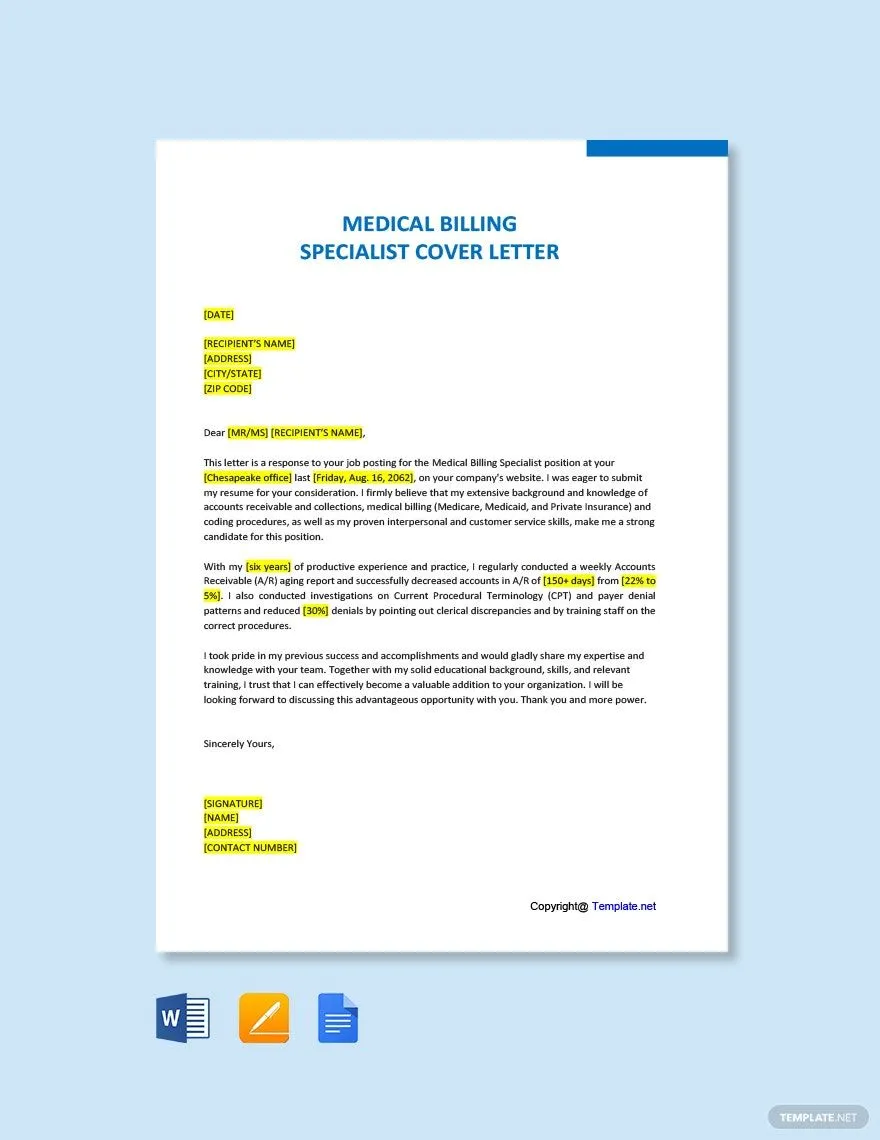
What is a Medical Coding Cover Letter
A medical coding cover letter is a document that accompanies your resume when applying for medical coding or billing positions. It serves as an introduction, a summary of your qualifications, and a way to express your interest in the specific role and the company. Unlike a resume, which provides a factual overview of your experience and skills, a cover letter allows you to showcase your personality, writing abilities, and enthusiasm for the job. It is your first opportunity to make a positive impression on a potential employer and convince them to read your resume and consider you for an interview. Crafting a well-written cover letter is crucial in the competitive field of medical coding and billing, where attention to detail and clear communication are essential skills.
The Importance of a Medical Coding Cover Letter
In the healthcare industry, where accuracy and precision are paramount, a cover letter can be a game-changer. It is a chance to personalize your application and explain why you are the ideal candidate for the position. A cover letter demonstrates your communication skills, attention to detail, and your genuine interest in the specific job and organization. It helps you stand out from other applicants by highlighting your relevant skills and experiences in a tailored manner. A compelling cover letter can be the deciding factor in getting your resume noticed and securing an interview. Moreover, a well-crafted cover letter reflects your professionalism and commitment to excellence, both of which are highly valued in medical coding and billing roles.
Key Components of a Strong Medical Coding Cover Letter

A strong cover letter is well-structured, professional, and tailored to the specific job you are applying for. A good cover letter should contain specific components to effectively communicate your qualifications to a hiring manager. Your cover letter must show that you have excellent skills and expertise to be a medical coder or biller, and that you are the right person for the job. Here are some vital sections you should include.
Header Information
The header of your cover letter should include essential contact information, ensuring the hiring manager can easily reach you. It should be displayed at the top of the document and includes your contact details and the date.
Your Contact Information
At the top left or right, list your full name, address, phone number, and professional email address. Make sure your email address is professional-sounding (e.g., john.doe@email.com) and that your voicemail is set up with a professional greeting.
Date

Include the date you are sending the cover letter. This is usually placed directly below your contact information or on the same line as your name.
Employer’s Contact Information
Directly below the date, include the hiring manager’s name (if known), their title, the company name, and the company’s address. This shows you have taken the time to research the company and the role.
Professional Salutation
Start your cover letter with a professional salutation. If you know the hiring manager’s name, use “Dear Mr./Ms. [Last Name].” If you don’t know the name, you can use “Dear Hiring Manager” or “Dear [Department Name] Team.” Avoid generic greetings like “To Whom It May Concern.”
Body Paragraphs

The body paragraphs are the heart of your cover letter. They are where you sell yourself and showcase your qualifications and enthusiasm. These paragraphs should be concise, impactful, and tailored to the specific job description. The purpose of this paragraph is to give the hiring manager a clear picture of who you are.
First Paragraph Introduce Yourself
Start with a brief introduction of who you are and what position you are applying for. Mention where you saw the job posting (e.g., Indeed, company website). State your enthusiasm for the role and the company. Highlight a key skill or experience that aligns with the job requirements to grab the reader’s attention. Be clear and concise, stating your intention to be considered for the open position.
Second Paragraph Highlight Skills
In this paragraph, discuss your relevant skills and experience. Use the job description as a guide and provide specific examples that demonstrate how your skills match the requirements. Mention any relevant certifications (e.g., CPC, CCS) and describe your proficiency in coding systems (e.g., ICD-10, CPT, HCPCS). Quantify your achievements whenever possible (e.g., “Improved coding accuracy by 15%,” “Processed an average of 50 claims per day”).
Third Paragraph Express Enthusiasm

Use this paragraph to express your genuine interest in the company and the role. Show that you have researched the company and understand its mission and values. Explain why you are drawn to the position and how you can contribute to the team. Mention any specific aspects of the company or role that excite you. Be enthusiastic and let your passion for medical coding shine through.
Closing Paragraph and Call to Action
The closing paragraph should summarize your interest in the position and reiterate your qualifications. Express your eagerness for an interview and mention your availability. Make it easy for the hiring manager to contact you. Include a clear call to action.
Formal Closing
End your cover letter with a professional closing, such as “Sincerely,” “Best regards,” or “Thank you.” Leave space for your signature (if printing the letter) and then type your full name.
Tips for Formatting Your Medical Coding Cover Letter

Proper formatting is essential for creating a professional and readable cover letter. Well-formatted cover letters are easier to read and demonstrate your attention to detail. Here are some formatting tips to keep in mind to make your cover letter more effective.
Keep it Concise
Aim for a cover letter that is one page long. Hiring managers are busy, and they will appreciate a concise and to-the-point document. Focus on the most relevant information and avoid unnecessary details or lengthy paragraphs. Use bullet points to highlight key skills or achievements to make the letter easier to scan.
Use Action Verbs
Start your sentences with strong action verbs to make your writing more dynamic and engaging. Examples include “managed,” “analyzed,” “implemented,” “improved,” “processed,” and “resolved.” Action verbs help you describe your accomplishments in a compelling way and demonstrate your skills and initiative.
Proofread Meticulously

Proofread your cover letter multiple times to catch any typos, grammatical errors, or formatting inconsistencies. A well-proofread letter shows your attention to detail and professionalism. Consider using grammar-checking software and asking a friend or colleague to review your letter before submitting it. Errors can undermine your credibility and may lead to your application being overlooked.
Tailor to Each Application
Do not send the same cover letter for every job application. Customize your cover letter for each specific position by highlighting the skills and experiences that are most relevant to the job description. Mention the company’s name and tailor your enthusiasm to their mission and values. This demonstrates your genuine interest and effort, making your application stand out.
Medical Coding Cover Letter Examples
Reviewing cover letter examples can provide valuable insights and help you structure your own letter effectively. There are different types of cover letters based on the applicant’s experience and the role they are applying for. Tailoring your cover letter to a specific role makes it more effective.
Example 1 Entry-Level

An entry-level cover letter is suitable for individuals with little to no experience in medical coding but with relevant education or certifications. The focus should be on your educational background, certifications, and any relevant skills learned during your training. Highlight your willingness to learn and your enthusiasm for the field. Demonstrate your understanding of the medical coding field, including key concepts and industry standards.
Example 2 Experienced Coder
An experienced medical coder’s cover letter should emphasize your professional experience and accomplishments. Highlight your years of experience, specific coding specialties (e.g., cardiology, oncology), and any relevant certifications (e.g., CPC, CCS). Showcase your ability to handle complex coding scenarios, improve coding accuracy, and manage large volumes of claims. Use specific metrics to demonstrate your value to the company, such as the number of claims processed or the percentage of coding accuracy achieved.
Example 3 Billing Specialist
A cover letter for a billing specialist should focus on your billing experience and skills. Highlight your knowledge of billing processes, claim submission, and insurance regulations. Mention your experience with billing software and your ability to resolve billing issues and manage accounts receivable. Showcase your communication skills, ability to work with patients, and your track record of reducing denials and improving revenue cycle management. Tailor your letter to show your billing expertise.
Medical Coding Cover Letter Mistakes to Avoid
Avoiding common mistakes can significantly increase the effectiveness of your cover letter. Here are some common errors to avoid.
Typos and Grammatical Errors
Typos and grammatical errors can damage your credibility. Make sure you have proofread the letter before submitting it to the hiring manager. Your attention to detail is very important in this field, and a cover letter full of errors can lead the hiring manager to question your skills.
Generic Language
Avoid using generic phrases and clichés. Use unique information about yourself. Instead of generic statements, provide specific examples that demonstrate your skills and experience. Tailor your letter to each job and company, showing that you are invested in the role and that you have what it takes to do the job.
Focusing on Yourself Too Much
While you need to highlight your skills, avoid making the cover letter all about you. Instead, focus on how your skills and experience can benefit the company. Show that you understand the company’s needs and can contribute to their success. Mention how you would benefit them.
Ignoring the Job Description
Do not ignore the job description. Tailor your cover letter to the specific requirements outlined in the job posting. Highlight the skills and experiences that match the job requirements. Demonstrate your understanding of the role. Ignoring the job description can lead to your application being overlooked.
Where to Send Your Medical Coding Cover Letter
Always follow the application instructions provided in the job posting. If the job posting specifies that you must submit your cover letter and resume through an online portal, do so. If the instructions do not specify, you can usually send your cover letter and resume as attachments in an email. Make sure your attachments are in PDF format to ensure that the formatting is preserved. Always include your cover letter and resume when applying for medical coding and billing positions. By following the guidelines and avoiding common mistakes, you can increase your chances of securing an interview and landing your dream job.