Highlighting Your Skills
As a new computer science graduate, your cover letter is your first chance to impress potential employers and secure an interview. Highlighting your skills effectively is crucial for making a strong first impression. This involves clearly and concisely presenting your technical abilities, project experiences, and any relevant soft skills. Remember, the goal is not just to list your skills, but to demonstrate how they align with the specific requirements of the job you are applying for. This section is your opportunity to stand out from the crowd by showing that you possess the necessary qualifications and a genuine interest in the role.
Technical Skills Showcase
Your technical skills are the foundation of your computer science expertise, and they should be prominently featured in your cover letter. Be specific and avoid vague statements. Instead of saying you have experience with programming, specify the programming languages you know and to what extent. Showcase your proficiency in various areas such as software development, data structures, and algorithms. This helps the employer quickly assess your suitability for the role.
Programming Languages Proficiency

Detail the programming languages you are proficient in. List languages like Java, Python, C++, or JavaScript. Indicate your skill level (beginner, intermediate, or advanced) and provide examples of projects where you used these languages. For instance, you can mention that you developed a web application using Python and Django, highlighting your ability to apply the language in a practical setting. This demonstrates your practical knowledge and allows the employer to quickly determine your fit for roles requiring specific programming skills.
Software and Tools Experience
Mention the software and tools you are familiar with, such as version control systems (Git), IDEs (like Eclipse or Visual Studio Code), database management systems (SQL, MySQL), and testing frameworks. Describe how you utilized these tools in your projects or academic work. For example, you might describe your experience using Git for version control on a collaborative project. This demonstrates your ability to work in a professional environment and use industry-standard tools efficiently.
Project Portfolio Presentation
Your project portfolio is a critical element of your application. It showcases your practical application of skills. Briefly describe each project, focusing on your role, the technologies used, and the outcomes. If possible, include links to your GitHub or personal website where your projects are available for review. This gives potential employers a tangible representation of your capabilities, allowing them to assess your skills in a more practical context beyond what’s on your resume.
Describing Relevant Projects

Select projects that are most relevant to the jobs you’re applying for. Highlight projects that demonstrate your understanding of the job’s requirements. For each project, include a brief description of the project’s goals, your specific contributions, the technologies used, and the outcomes achieved. If the project addressed a real-world problem, be sure to highlight this. This enables the employer to see how your skills can be applied to their specific challenges.
Quantifying Achievements
Whenever possible, quantify your achievements in your projects. Instead of saying that you ‘improved the website speed,’ state that you ‘reduced page load times by 30%’ by optimizing images and code. Quantifiable results make a stronger impact and show that you understand the value of your work. Use metrics such as the number of users, performance improvements, or cost savings achieved through your projects. This approach illustrates the tangible benefits you bring to the table and enhances your credibility.
Formatting and Structure
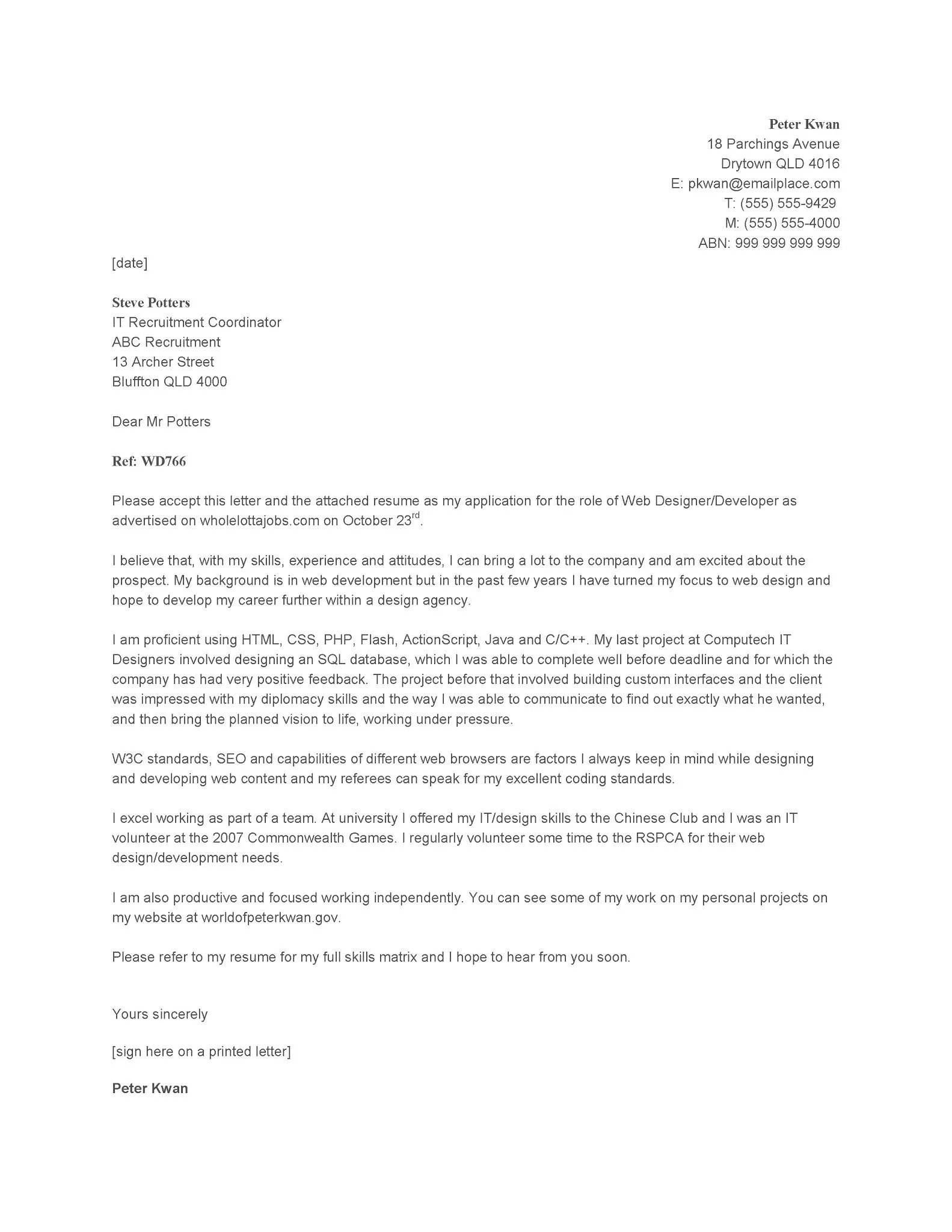
The formatting and structure of your cover letter are just as important as the content. A well-formatted cover letter is easy to read and reflects professionalism. It shows that you pay attention to detail and can communicate clearly. Ensure your letter is well-organized, with clear headings and paragraphs, and uses a consistent font and style. The following sections detail how to structure your cover letter effectively.
Header and Contact Information

Start your cover letter with a professional header that includes your name, contact information (phone number and email address), and the date. You can also include links to your LinkedIn profile and personal website or portfolio. This information should be easily accessible, allowing recruiters to quickly reach you. Ensure that your email address is professional and that your LinkedIn profile is up-to-date and showcases your skills and experience.
Professional Greeting
Use a professional greeting, such as ‘Dear [Hiring Manager name]’ or ‘Dear [Company Name] Hiring Team.’ If you can’t find the name of the hiring manager, it’s acceptable to use a general greeting like ‘Dear Hiring Manager.’ Avoid overly casual greetings. This sets a formal tone and shows respect for the recipient. Research the company and role to find out who the hiring manager is, adding a personal touch and demonstrating your genuine interest.
Body Paragraphs Strategies
The body of your cover letter should be divided into a few paragraphs, each focusing on a specific aspect of your qualifications and interest in the role. Start with a brief introduction that states the position you’re applying for and how you found the job. The subsequent paragraphs should highlight your skills, project experiences, and why you are a great fit for the company. Remember to keep each paragraph concise and targeted. You can use the STAR method (Situation, Task, Action, Result) to structure your paragraphs and showcase how you’ve used your skills to solve problems.
Tailoring to the Job Description

Customize your cover letter for each job application. Carefully read the job description and identify the key skills and requirements. Then, highlight your relevant skills and experiences. Use keywords from the job description in your cover letter. This shows the employer that you have the qualifications they are looking for, increasing the chances of your application being noticed. Demonstrating this attention to detail and the effort to tailor your application sets you apart.
Expressing Enthusiasm
Express your genuine enthusiasm for the position and the company. Explain why you are interested in the role and what attracts you to the company’s mission or values. Showing that you have researched the company and are genuinely interested in working there can make a strong positive impression. Mentioning any company projects or initiatives you admire shows your genuine interest and initiative.
Call to Action
Conclude your cover letter with a clear call to action. Reiterate your interest in the position and express your eagerness to discuss your qualifications further. Thank the hiring manager for their time and consideration. Provide your contact information again, and state that you look forward to hearing from them soon. This final touch reinforces your interest and makes it easy for the hiring manager to contact you.
Proofreading and Editing

Proofreading and editing are critical to ensuring that your cover letter is free of errors and presents you in the best possible light. A cover letter riddled with typos or grammatical errors can damage your chances. Take the time to review every word and sentence, checking for any mistakes. This step demonstrates your attention to detail and commitment to quality, reflecting your professional attitude and improving the credibility of your application.
Checking for Errors
Carefully check for spelling, grammar, and punctuation errors. Ensure your sentences are well-structured and that your language is clear and concise. Use a spell checker and a grammar checker, but don’t rely on them entirely. Manually review your cover letter to catch any mistakes that automated tools might miss. Pay attention to consistency in formatting, capitalization, and the use of pronouns and verbs. Every error detracts from your professionalism.
Seeking Feedback
Ask someone else to review your cover letter. A fresh pair of eyes can catch errors that you may have missed. Ask friends, family members, or career counselors to review your letter and provide feedback. Their insights can help you improve the clarity, content, and overall effectiveness of your cover letter. Be open to their suggestions and make the necessary revisions. Receiving feedback is an excellent way to refine your cover letter and increase your chances of landing an interview.