Why a Bank Cover Letter Matters
In the competitive world of banking, a cover letter serves as your first impression, often more impactful than your resume alone. It’s a crucial tool for setting yourself apart from other applicants and demonstrating your genuine interest in the position and the bank itself. A well-crafted cover letter provides an opportunity to elaborate on your skills, experiences, and qualifications in a way that a resume cannot. It showcases your personality, writing abilities, and your understanding of the banking industry. The cover letter is your chance to tell a story, highlighting your achievements and explaining why you are the perfect fit for the role, making it a critical element in the job application process.
Understanding the Importance of a Cover Letter
Beyond the initial impression, a cover letter allows you to connect your skills and experiences directly to the specific requirements of the job. It’s a chance to explain how your qualifications align with the bank’s needs and to articulate your career goals. The cover letter provides a platform to demonstrate your research and understanding of the bank’s values, mission, and culture. By tailoring the letter to each position and bank, you show that you are genuinely invested in the opportunity. The best cover letters focus on how you can contribute to the bank’s success, making you a memorable candidate and increasing your chances of getting an interview.
Highlighting Your Unique Selling Points (USPs)

A cover letter is the perfect place to showcase your Unique Selling Points (USPs). These are the specific skills, experiences, or qualities that make you stand out from other candidates. Consider what makes you unique. Maybe you have exceptional customer service skills, a proven track record in sales, or strong analytical abilities. Articulate these USPs with concrete examples. For instance, instead of saying ‘I have strong communication skills,’ describe a situation where you successfully resolved a customer complaint, highlighting your approach and the positive outcome. Similarly, if you excel in sales, provide data showing your sales achievements, like exceeding sales targets by a specific percentage. Use the cover letter to tell your story, highlighting your USPs to demonstrate your value to the bank.
Researching the Bank and the Role
Before writing your cover letter, thoroughly research the bank and the specific role you are applying for. Visit the bank’s website to understand its mission, values, and current initiatives. Explore its social media presence to get a sense of its culture and recent activities. Understand the job description completely. Identify the key responsibilities, required skills, and preferred qualifications. Tailor your cover letter to address these requirements directly. Use the bank’s language and incorporate keywords from the job description. Demonstrate your knowledge of the bank and the role to show that you are serious about the opportunity. By showing that you have invested time in this research, you demonstrate a genuine interest in the bank and the position.
Demonstrating Your Knowledge of the Bank
Showcasing your knowledge of the bank is a powerful way to make your cover letter stand out. Mention specific bank initiatives, recent achievements, or values that resonate with you. This demonstrates that you have gone beyond a surface-level understanding and are genuinely interested in the bank’s work. You can refer to recent news articles, community involvement, or any other information that highlights the bank’s success and commitment. Connect your skills and experiences to these examples to show how you can contribute to the bank’s ongoing success. By demonstrating this level of awareness, you prove that you’re not just looking for a job but are also looking to contribute to the bank’s mission, making you a more attractive candidate.
Tailoring Your Cover Letter

Never send a generic cover letter. Each cover letter should be customized to the specific job and bank you are applying to. Review the job description and highlight the key requirements and skills. Then, demonstrate how your qualifications match those needs. Modify your cover letter to emphasize the skills and experiences most relevant to the role. Include specific examples from your work history that show how you have successfully used those skills in the past. If the job requires customer service experience, share a situation where you went above and beyond to assist a customer. If the job requires financial analysis, describe how you have used analytical skills in previous positions. Always personalize your cover letter. Show the bank that you are serious about the role.
Key Components of a Bank Cover Letter
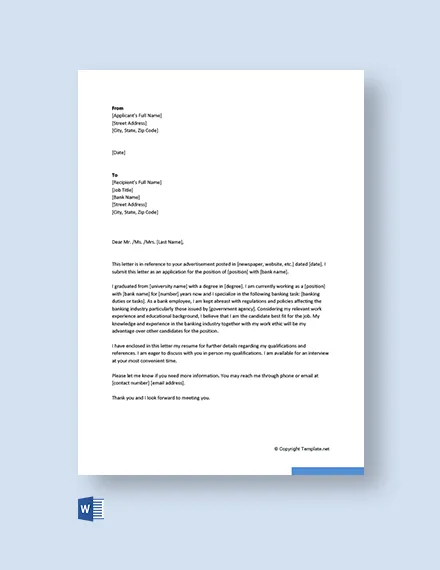
A well-structured cover letter includes the following essential elements: a professional heading with your contact information, the date, and the recipient’s details. The opening paragraph should grab the reader’s attention, stating the position you’re applying for and where you saw the job posting. In the body paragraphs, highlight your relevant skills, experiences, and achievements. Use examples and quantify your accomplishments whenever possible. Conclude with a strong closing paragraph summarizing your interest and reiterating your qualifications, and a clear call to action. Always end the letter with a professional closing, such as ‘Sincerely’ or ‘Respectfully,’ followed by your typed name. Use a clear and consistent font, and ensure that there are no grammatical errors or typos.
Crafting a Strong Opening Paragraph
Your opening paragraph is your first chance to capture the reader’s attention. It should be concise, engaging, and clearly state the position you are applying for and where you found the job posting. Instead of a generic opening, try to personalize it. If you know the hiring manager’s name, address them directly. Express your enthusiasm for the role and the bank. Immediately mention your most relevant skill or experience to pique the reader’s interest. For example, you could start with: ‘I am writing to express my enthusiastic interest in the Teller position at [Bank Name], as advertised on [Platform].’ Show that you have researched the bank, and explain why their values align with yours. A compelling opening makes the reader want to learn more.
Showcasing Your Relevant Skills and Experience
The body of your cover letter should highlight your relevant skills and experiences. Carefully review the job description and identify the key skills and qualifications the bank is seeking. Then, provide specific examples from your work history that demonstrate those skills. Use the STAR method (Situation, Task, Action, Result) to structure your examples. Describe the situation, explain the task you were assigned, detail the actions you took, and explain the results you achieved. If the job requires experience in customer service, describe a situation where you went above and beyond to help a customer. If the job requires financial analysis skills, outline a project where you used analytical skills to improve financial performance. Quantify your accomplishments whenever possible by including numbers or percentages to showcase your impact.
Quantifying Your Achievements
Quantifying your achievements is a powerful way to make your cover letter more impactful. Instead of simply stating that you improved customer satisfaction, provide specific metrics. For example, say ‘Increased customer satisfaction scores by 15% within six months.’ If you improved sales performance, state how much you increased sales by. For example, you can say ‘Increased sales by 20% in the first quarter.’ Whenever possible, use numbers, percentages, or other quantifiable data to demonstrate your accomplishments. This gives the hiring manager clear, concise evidence of your skills and experience. By providing these metrics, you provide concrete proof of your success. Numbers speak volumes and allow the reader to fully understand your value.
Addressing Skills and Qualifications
When addressing your skills and qualifications, make sure to align them with the job requirements. Carefully analyze the job description and identify the essential skills and qualifications. Organize your cover letter to address each of these requirements directly. Use keywords from the job description. If the job requires strong communication skills, provide an example of a situation where you successfully communicated with customers or colleagues. If the job requires specific software knowledge, mention your proficiency with that software and provide examples of how you have used it in the past. Show how your qualifications meet the needs of the role, demonstrating that you are an excellent fit for the position. By addressing each skill and qualification, you increase your chances of catching the hiring manager’s attention.
Writing a Compelling Closing Paragraph

Your closing paragraph is your last opportunity to make a strong impression. Summarize your interest in the position and reiterate your key qualifications. Briefly express your enthusiasm for the role and the bank. Restate your value proposition and remind the reader why you are the ideal candidate. Keep it concise and impactful. Don’t introduce new information or skills. The closing paragraph should reinforce the message you have already conveyed. Avoid generic phrases such as ‘Thank you for your time and consideration.’ Instead, create a call to action to encourage the hiring manager to contact you. Finish with a professional closing, such as ‘Sincerely’ or ‘Respectfully,’ followed by your typed name.
Call to Action
Include a clear call to action in your closing paragraph to prompt the hiring manager to take the next step. This could be a request for an interview. Be direct and state that you are eager to discuss the opportunity further. You could say ‘I am eager to discuss how my skills and experience can benefit [Bank Name]. I am available for an interview at your earliest convenience.’ Include your phone number and email address to make it easy for the hiring manager to contact you. Make it clear that you are proactive and ready to move forward with the application process. By including a call to action, you increase the likelihood of receiving a response and moving your application to the next stage.
Formatting and Presentation
The formatting and presentation of your cover letter are as crucial as its content. Use a professional and easy-to-read font, such as Times New Roman, Arial, or Calibri. Keep the font size between 10 and 12 points. Ensure that your cover letter is well-organized with clear headings, subheadings, and plenty of white space to make it easy to scan. Use bullet points to highlight key skills or accomplishments. Ensure your letter is properly aligned and has consistent margins. Keep your letter concise. Aim for one page unless the job description explicitly asks for more. Ensure your cover letter is free of typos and grammatical errors. Poor formatting and presentation can create a negative impression and detract from the content of your cover letter.
Proofreading and Editing

Always proofread and edit your cover letter carefully before submitting it. Check for any typos, grammatical errors, and inconsistencies. Ask someone else to review your cover letter to catch mistakes you might have missed. A fresh pair of eyes can often identify errors that you have overlooked. Pay close attention to sentence structure, punctuation, and spelling. Use a grammar and spell-checking tool, but remember that these tools are not foolproof. They can sometimes miss errors or provide incorrect suggestions. After you have made the necessary revisions, read the letter aloud to ensure that it flows well and makes sense. A polished, error-free cover letter is essential to demonstrate your attention to detail and professionalism.
What to Avoid in Your Bank Cover Letter
Avoid common mistakes that can harm your chances of getting noticed. Do not use generic, impersonal language. Always tailor your letter to the specific job and bank. Refrain from using jargon or overly complex language. Keep the language straightforward and professional. Do not include negative comments about past employers or jobs. Focus on your achievements and the positive contributions you can make to the bank. Avoid exaggerating your skills or experiences. Be truthful and honest. Do not send a cover letter with typos, grammatical errors, or formatting issues. Always proofread and edit your cover letter carefully. Avoid any irrelevant information or personal details that do not pertain to the job. Focus on your qualifications and the bank’s needs.
Common Mistakes to Steer Clear Of
Several common mistakes can damage your chances of getting an interview. Avoid generic cover letters by tailoring each letter to the specific job and bank. Do not repeat information from your resume verbatim. Use the cover letter to elaborate on your skills and experiences. Avoid using clichés or overly formal language. Use a natural, professional tone. Do not send a cover letter without proofreading. Typos and grammatical errors are easily avoided and create a poor impression. Refrain from including any negative information about previous employers or colleagues. Focus on your positive qualities. Ensure that you meet all the requirements and include the details that are requested in the job description.
Cover Letter Examples for Bank Positions

Review cover letter examples for various bank positions to get an idea of how to structure and format your own letter. These examples can help you understand how to highlight your skills and experiences effectively. You can find these examples from different job search websites or career resources. Make sure the examples are relevant to your position and industry. Use them as a guide, and remember to customize your cover letter to your specific qualifications and the job requirements. Adapt the language and examples to showcase your unique strengths.
Example for Teller Position
For a Teller position, your cover letter should emphasize your customer service skills, cash handling experience, and attention to detail. Highlight any experience with cash registers, banking software, and handling financial transactions. Show your ability to work with customers in a friendly and professional manner. Mention any relevant certifications or training you have. Example: ‘I am writing to express my interest in the Teller position at [Bank Name]. I have three years of experience in customer service and cash handling, as well as a proven track record of accuracy and excellent customer interactions.’ This shows your experience and interest, as well as sets you apart.
Example for Loan Officer
For a Loan Officer position, you should highlight your experience in loan origination, credit analysis, and customer relationship management. Mention your knowledge of lending regulations and your ability to assess loan applications. Demonstrate your skills in financial analysis and your ability to manage risk. Example: ‘I am writing to express my interest in the Loan Officer position. I have five years of experience in loan origination and a strong understanding of credit analysis, enabling me to assess loan applications and manage risk effectively.’ This demonstrates your knowledge of the industry and highlights your experience.
Example for Bank Manager

For a Bank Manager position, emphasize your leadership skills, management experience, and ability to drive results. Highlight your experience in managing a team, improving operational efficiency, and achieving financial goals. Showcase your ability to develop and implement strategies and your strong knowledge of the banking industry. Example: ‘I am excited to apply for the Bank Manager position. I have a proven track record of leading and developing high-performing teams, increasing efficiency, and exceeding financial targets.’ This highlights your experience, management skills, and interest in the position.
Final Tips for Success
Before submitting your bank cover letter, double-check everything. Proofread it meticulously for errors in grammar, spelling, and punctuation. Ensure that you have tailored your letter to the specific job description and bank. Verify that your contact information is accurate and up to date. Ensure that your formatting is consistent and professional. Send the cover letter as a PDF file to maintain the formatting. Review the bank’s website and social media presence to stay updated on current events. Before the interview, prepare by researching common interview questions. The bank cover letter is your first step in the application process. A well-crafted cover letter will make you stand out.